Showing posts with label fitting. Show all posts

Saturday, June 06, 2015

Colette Pastille: WTF

When last we spoke about my Pastille dress, I was doing a mommy-tummy adjustment on the skirt.  The plan was that if that went okay, I would then make one final muslin of the bodice that incorporated all of the changes, sew them together and make one last check for fit.

I made this skirt and tried it without the bodice:
The old, stand-on-a-stool-so-you-can-see-your-skirt-in-the-
bathroom-mirror trick.  I really need a full-length mirror
in the living room where my sewing machine lives.
As you can see, it looks pretty good.  The side seam looks straight although it might be a tiny bit forward right at the waist.

So, I attached bodice muslin 3 to it to see how it looked:

Please excuse whatever was on the bathroom mirror.
Toothpaste maybe?  I dunno, I live with a 3 year old, it
could be anything.
Also not bad.  Actually, pretty good!

At this point, I got really excited and made up the bodice in the same red fabric as the skirt and sewed them together.

Disaster.

First, I thought I would use bias tape for the neckline instead of a facing because facings annoy me and that was a hot mess that I won't be repeating.  But, I figured it was fine, because I didn't really care about this fabric so I could throw it all away if I wanted.  But then, I looked in the mirror and I got so disgusted, I couldn't even take a picture.  The bodice felt funny.  Maybe from the mess at the neckline?  I dunno.  Worse there were diagonal pull lines in the front skirt.  Ugh!

I tried it on again today and this time I took pictures in order to share the horror:
Ignore my hair, I hadn't gotten ready for the day, yet.

I spent a lot of time trying to stand in the mirror in a way
that most obscures the mess on the floor behind me.


It looked like maybe the bodice was pulling the skirt up in the front so I let out the bodice seam in the front.  I overcast the seam allowances together so it's essentially got a 1/4" seam at the waistline:


Better, but I don't get why the bodice is suddenly too short.  I need to take it apart and compare it to the previous bodice muslin and the pattern piece.  At any rate, it looks like I need to add half and inch to the front bodice and front skirt.

There's still some pooling and wrinkling of fabric in the upper back of the bodice while the lower back is now looking a bit too tight (maybe?).  I need to pinch out the excess at the top and maybe fix the swayback adjustment, I think.


Whatever it needs, it's going into time-out for awhile to think about what it's done while I work on the Outfit Along (Bad, bad, bad Pastille!  Mommy is not happy with you!).  I'll pull it out once I've finished the dress for the Outfit Along (so, the end of July?).

Monday, May 18, 2015

Colette Pastille: Skirt muslin #2

So, when last we saw the Pastille muslin, I had finished bodice #3 and I was feeling pretty good about it having cut a smaller size in the waist and completed an FBA and a swayback adjustment.  The next step was to make a second muslin of the skirt.*  For this iteration, I had cut a smaller size and done a swayback adjustment.

Bathroom photos are the worst
What you can't really see is that it's still too baggy at the side seams in between the waist and hips.


Please ignore the potty chair in the background

 On the other hand, I have a textbook case of "prominent abdomen"**.


Here, I've taken in the sides of the skirt going from the waist to the hip and let it out a bit at my upper thighs.  That has helped with the prominent abdomen but it's still not quite right.

Next step is to try the pot-belly alteration for pencil skirts by Maria Denmark found on the By Hand London blog here.  Right after I took this picture, I drew a line just under my post-baby belly that curved up to the hipline, like on the tutorial.  Then, I cut along that line, let the fabric fall in front and pinned Swedish tracing paper to the skirt across the gap so that I could preserve the size of the gap when I took the skirt off.

Cutting line

Now, I need to transfer that slash and spread to the paper pattern, along with the seamline adjustments and cut a new muslin for the skirt.  Onward to skirt muslin #3!


*The first bodice muslin was so awful that I didn't bother making the skirt at the time, I just went straight to making a second bodice muslin.

**Or as I like to call it, post-baby belly.

Tuesday, October 16, 2012

KCWC: Wrapping up

The Kids Clothes Week Challenge ended yesterday and I'm pretty pleased with what I managed to accomplish! 

Sewing

1. Cate's Blue Pants
Cate's Photoshoot or Why It's Difficult to Get Good Pix of Handmade Baby Items
Image Copyright Elisabeth Montegna, All Rights Reserved

Pattern:  Big Butt Baby Pants by Made by Rae
Fabric:  Navy Blue Cotton Sateen (remnant from blue Meringue)
Notions:  1/2 inch non-roll elastic
Notes:  I cut a 12-18 mos size because Cate is nearly 11 mos and I want her to be able to wear these for awhile.  They were, not to put too fine a point on it, GINORMOUS.  Of course, eventually they would fit her (you know, maybe in March, or possibly June) but I wanted her to be able to wear them now.  There are no side seams, so I just pinched some fabric and sewed up each side, taking them in by 1.5 inches total.  Then, I folded the waistband over twice, thus removing an inch from the top, and made a very wide hem at the bottom, taking about 2 inches off of the length.  I measured her waist and sewed the waistband as directed (leaving a little extra elastic on the ends so I can let out the waist later).  However, the pants kept sliding down her butt, so I tightened them up this evening. I trimmed all of the seam allowances and zig-zagged the seam allowances together.

2.  I Like Big Butts and I Cannot Lie

Pattern:  Big Butt Baby Pants by Made by Rae
Fabric:  Stretch Denim (remnant from an ill-fated maternity skirt)
Notions:  1/2 inch non-roll elastic, single-fold bias tape
Notes:  I really liked how the first pair of BBB pants turned out, so I decided to make a second pair out of a denim remnant I had laying around (I love that I can use my remnants to make clothes for Cate!).  This time I cut a size 6-12 mos on all sides except the bottom hem which I cut at the 12-18 mos length so that I have plenty of fabric to let them out.  No pictures because I haven't finished them yet.  This time I'm finishing the seams with single-fold bias tape.

3.  Little Red Riding Hood Cape

Pattern:  Maisie Cape
Fabric:  Robert Kaufman 21 wale corduroy and Moda A Walk in the Woods/Bluebell Mushrooms; both purchased from Purl Soho
Notions:  Velcro
Notes:  This project is still in its infancy since I just got the fabric.  I need to figure out how I should go about getting the wrinkles out of the corduroy (I have this feeling I'm not supposed to just iron it) and there is a slight issue with the Bluebell Mushrooms lining fabric (see below).  I'm going to start cutting it out as soon as I finish BBBP #2, though, since Halloween is coming soon.

Knitting

1.  Purple Cardigan

Pattern:  Anya Cardigan from Vintage Knits for Modern Babies
Yarn:  Knitpicks Comfy in Blackberry
Needles:  US sizes 3 and 5 circulars
Buttons:  Good question!
Notes:  I've been working on this cardigan for forever and a day it seems.  Fortunately, I like how it's turned out!  I still need to pick out buttons, however.  I'm having a bit of difficulty with that seemingly simple task.  I've got some vintage metal buttons with little flowers on them, but I'm not sure if I can wash them and I don't want to have to snip them off and reattach them every time I wash the cardigan (and, seeing as how it's for a baby, the cardigan will likely be washed frequently).  I've thought about somehow pinning them on, but I'm a little nervous about putting pins in Cate's clothes, even if they are safety pins.  Anyone have any ideas about how to get around this issue (aside from using different buttons which I have already thought of!)?  I also want to add grosgrain ribbon to the button bands to help stabilize them, but otherwise the cardigan is done.  I hope to get pix of it soon.

Lessons Learned

1.  Setting aside time to craft for an hour a day does my heart and soul good.  It also means my projects move along faster.  Not just because I'm actually setting aside time to work on them but also because committing to an hour of crafting everyday means I'm less likely to rush to get something done.  This results in fewer mistakes, less ripping out, and more forward progress.

2.  Don't order fabric at 3AM.  I meant to order 1.5 yards of the Bluebell Mushrooms fabric and instead ordered 0.5 yards.  I'm going to call around to local quilt shops to see if I can find more because I really don't want to pay shipping again!

3.  My baby is not as big as I think.  However, better to make something too big than too small!


Tuesday, September 25, 2012

Now what?

I've been thinking about my crafting priorities for the rest of the year.  While looking through A Verb for Keeping Warm's website, I came across a group endeavor called Seam Allowance.  The members pledge to work toward increasing the number of handmade items in their wardrobe to be at least 25% of the total.  Practically speaking, they are talking about being able to wear at least one handmade item every day (this includes accessories, such as scarves, jewelry, and headbands/hats/fascinators, etc.).  This seems like a very worthy goal and a good way to be a bit more thoughtful about your wardrobe and your creating. 

For instance, if you are hoping to wear one handmade item a day and you don't usually wear a lot of dresses (and don't want to), then your sewing goals should reflect that.  Sunni of A Fashionable Stitch has been talking about this issue as well.  You may really enjoy sewing dresses, but if you never wear them you might want to curb your enthusiasm a bit.  Likewise, you should think about sorts of clothes you wear everyday and if they are the kind of clothes you want to wear or are you looking for a change.  Then, you can plan your sewing/knitting/crocheting/weaving/jewelry-making appropriately.

Right after I had Cate, I really tried to dress thoughtfully most days.  I was (and still am) worried about "letting myself go."  It's so easy, after having a baby, to wear yoga pants and a t-shirt most days, just put your hair in a ponytail, and forget about make-up, but it seems to be difficult to break that habit.  So, I worked on wearing business (very) casual most days and tried to put on make-up everyday.  However, I let that slip somewhere along the line.  Maybe it was because as Cate became more aware of and involved in her surroundings, it was harder for me to find time to put myself together each day.  Whatever the reason, these days I throw on whatever's handy and rarely wear make-up.

I want to get back to being more thoughtful about my appearance.  I almost always feel better (happier, more self-confident, less self-conscious) when I feel I am dressed well.  I want to put on clothes that make me feel good, not just whatever is easiest (and still clean!).  This is going to take some thinking about what I would like to wear and what is practical to wear (since I spend quite a bit of time on the floor with Cate, or chasing after her, or having her suddenly start gnawing on my leg).

My Meringue skirt was a step in that direction.  I made it out of navy blue cotton sateen with no embellishments beyond the scalloped hem.  It's comfortable, practical, looks good, and, because it's fairly plain, it can be worn more than once a week.  It's a neutral color so it should go with most of the shirts I own.  It's lined (or rather, it soon will be) so that I can wear it with tights in the winter.  I need to finish up this Meringue, however.  I barely got it wearable in time for the launch party.  I did that by not lining it and choosing to ignore a few issues (like the puckering at the hem).  I still need to cut, sew, and attach the lining, fix the puckers, finish some seams and fix a couple of issues with the zipper.  I'm hoping to get that done by the end of the week.

But, what to work on after I finish the Meringue?
  • Meringue v2.0:  I should have done a swayback adj. for Meringue v1.0, so I'm going to try to do that in Mv2.0.  I'm also thinking about playing with some piping and using contrast fabric for the facings and attaching them to the outside.  I have a khaki cotton sateen similar to the navy I used for Mv1.0 and I was thinking of dark brown gingham for the facings.  That will make it different enough from Mv1.0, but still neutral/basic enough to wear with most things in my wardrobe.
  • Renfrew:  The weather in the bay area is such that I could probably spend most of the year wearing 3/4 sleeve shirts, but I don't often find 3/4 sleeve t-shirts that I like.  Therefore, I purchased the Renfrew pattern from Sewaholic which comes with three neckline styles and three sleeve styles.
  • A button-down shirt:  I'm trying to get away from wearing t-shirts all the time.  I don't want to get rid of them completely (which is why I want to make a Renfrew or three), but I would like to be able to wear a fitted button-down shirt once in a while.  Unfortunately, my bustline makes it difficult to find a RTW fitted button-down shirt that actually fits well.  Sewing to the rescue!  I'm not sure what pattern I'll use for this project.
  • Thurlow trousers:  Another Sewaholic pattern.  I would love to wear skirts every day, but, realistically, that's not practical at this time in my life.  However, I have a helluva time finding pants that fit properly.  Between having a curvy figure, large thighs, a super-long crotch depth, and a swayback, it's really a miracle I can find RTW pants that fit at all!  Fortunately, I have one pair of jeans that actually fits fairly well and since I know the rise/crotch-depth is right on these jeans, I'll measure them and use that measurement as a starting point for my muslin.  The pattern is geared toward pear-shaped women, and while I'm not exactly pear-shaped, I do have all of the issues the pattern is supposed to address.
So, that's my current sewing queue.  Next up:  my knitting queue!


Saturday, September 22, 2012

No waistband

I'm not sure what is going on, but every time I try to add a waistband to Meringue, it throws off the fit.  So, I'm doing away with the waistband.  I really would like to have this skirt done by tonight and I'm starting to realize that part of my problem with sewing right now is perfectionism.  I could fuss with this skirt for eternity and never achieve perfection.  And therefore, never have a skirt.  Well, basta!  Enough!  I'm going to sew this skirt sans waistband and I will love it and wear it to death!

Friday, September 21, 2012

A change of plans

Previously, on e-beth knits:

In trying on the Meringue muslin:  the skirt had no ease, the waistband gaped, and there was fabric pooling above my butt.

The next day, I decided to try the muslin on again--this time with a pair of Assets on board and without the waistband.  I also tried the advice of Palmer-Pletsch and let out the front darts over my "full tummy" (or as I like to call it, "that part of my body that has not been the same since pregnancy").  At that point, it seemed like I had a ridiculous amount of extra fabric at the side seams.  So, I pinned it in at the sides, and compared it to the pattern.  Now it appeared I should cut a 12 at the waist, expanding to a 14 by the hips (I originally cut an 18).  I modified my paper pattern accordingly, took out the side seams of my muslin, drew the new seamline, and tried it on again.

It looked awesome (well, as awesome as a muslin can look)!  I'm not sure how to explain how I went from needing to add extra room to a size 18 muslin to taking in that same muslin several sizes.  I mean, I know letting out the darts and wearing shapewear helped, I just don't see how it could have helped that much.

I still think I want a waistband and I drafted one last night but then didn't have time to cut it out and try it on the muslin.  I'll do that tonight and then (fingers crossed!) I'll cut the fashion fabric as well.  I'm not sure I'll have much time on Sat. to sew which means I'll need to get as much as possible done tonight.  I can see myself wearing jeans and hemming my skirt at the Bay Area Sewists Meetup that's before the launch party, then putting on the skirt right before the launch.  :)  I don't think there's any way I'll get the lining put in by tomorrow afternoon, either, but I can add that afterward.

Wish me luck!

Thursday, September 20, 2012

Meringue (hold the lemon)

This weekend, the Colette trunk show is coming to a local fiber store, A Verb for Keeping Warm (Verb carries yarn, fiber for spinning, knitting, spinning, and weaving supplies, and fabric).  As soon as the date was announced, I knew that I wanted to make a garment from a Colette pattern to wear to the show/party, so I decided to make the first project in The Colette Sewing Handbook, Meringue.

Meringue is a scalloped hemmed, slightly A-line skirt.  There are two skirt pieces--the front and back--plus the facings, and a side invisible zip.  I am adding a waistband to the pattern because I think that will be more flattering for my figure type.  I am also lining the skirt so that I don't need to wear a slip.  The fashion fabric is a navy blue cotton stretch sateen from Joanns and the lining is a fuschia poly lining material.  I've decided that I will hem the lining to where the scallop-hem facings end because I don't want to deal with a scallop-hemmed lining.

I tried to do a tissue fitting Monday night and gave up in frustration, which was what prompted me to write the Tissue Fitting is Dead to Me post.  Next, I cut out the front and back in cheap broadcloth, sewed the darts and seamed the sides together.  Then, I needed to think about the waistband.  Colette has a tutorial for making a waistband for Meringue which involves slashing the pattern near the top, adding seam allowances to both pieces and then sewing the top piece as the waistband.  I like this idea, but I decided that I wanted the skirt to sit higher on my waist and I didn't want to show more leg.  So, I decided to try Gertie's method of making a waistband (tutorial here, but I used the method from her new book which is slightly different).  In her book, Gertie says that the waistband pattern can be used with any skirt type, so I thought it would work for my skirt.  I sewed the waistband and attached it to my skirt and tried on the skirt.

Several issues showed up right away:
  • The skirt had no ease.  I wanted it to be fairly fitted but this was a little over the top.  To add ease to the skirt, I think I'm going to make my seam allowances 3/8 inch instead of 5/8 inch.  That adds 1/2 inch to the body of each side of the skirt resulting in 1 inch of ease over all.  I think this will be plenty because the fabric has some stretch to it.
  • The waistband gaped.  This is likely due to my swayback.  I think this problem may be solved by using a curved waistband.  Therefore, I'm going to draft a waistband by closing the darts and tracing the top of each pattern piece, adding two inches in height, adding 5/8 seam allowance to all sides, and adding one inch in length to the front waistband piece so that I can make a tab.
  • Fabric pooling just above my butt.  This is also a swayback issue, I think, and will hopefully be solved by taking a wedge shaped tuck near my waist in the back.
So, I'm going to try drafting the waistband and trying it on my muslin.  I'll also take the tuck out of my muslin and transfer it to the paper pattern.  If all goes well, I should be able to start cutting my fashion fabric soon.  Cross your fingers for me, because the weekend is fast approaching!

Wednesday, September 19, 2012

Tissue Fitting: Not a fan

So, for Christmas last year, I received the Palmer-Pletsch book, Fit for Real People.  Since then, I have been trying to follow their advice as much as possible, and their method is based almost entirely on tissue fitting.  They claim that if you do a good tissue fit, then you don't need a muslin.

Well, frankly, tissue fitting is just not working for me.  I had my doubts about it to start with, really.  I mean, generally speaking, tissue is not going to act the same as fabric.  I've been tracing my patterns onto Swedish tracing paper (the idea being that I could actually baste it together at the end and sort of have a muslin), but I think this is actually making things worse not better.  The Swedish tracing paper is pretty stiff and, as I'm not making everything in taffeta, doesn't give me anything near an accurate representation of how the garment will actually lay once I make it in fabric.  Tissue paper is a little better, but I don't like working with it because it's too delicate and prone to ripping.  This is why P-P recommends stabilizing certain areas.

Well, I've come to realize that, by the time I trace off the pattern, mark the seam allowances, put tape everywhere I'm supposed to put tape, then snip to the seam allowance in the armholes and tape the thing together and try it on, well, I could have cut out a muslin, basted it together, and seen how things actually look in fabric.  So, that's what I'm going to do from now on.  I will buy fabric that I don't necessarily like but is being offered at rock bottom prices and use it for muslins.  Thrifted sheets seem to be a popular source of muslin fabric, so I'll stop by goodwill and see what I can find.  In the meantime, I have some cotton broadcloth I got on sale at Joanns that I'll use, and I do have actual muslin fabric that I can use, too.

Knitting News
I'm almost done with Cate's sweater.  I have the major pieces knitted.  Now, I need to sew the sleeves into the armholes and knit the collar.  I've been needing to do that for a week, but I haven't found time to sit and carefully attach the sleeves (sewing seams is not my strong point). 

Saturday, May 05, 2012

Dart Difficulty


So, you're probably wonder how that Sorbetto top is coming.  Well, currently, it's not.  I was hoping to have it done by the time we left for Iowa for Cate's baptism, but we have gone and come back and still no Sorbetto.

When last we spoke re: Sorbetto I had made a boat-load of adjustments and adjusted the dart height on my muslin.  After that, I took it totally apart and transferred the new dart position and the sloped shoulders adjustment to my paper pattern which is now made out of Swedish Tracing Paper (love that stuff!).  Then, I made a new muslin in quilting cotton with the thought that if it came out okay, I would bind the neck and armholes and add it to my wardrobe.

Fig. 1.  A boat-load of
adjustments
Well, it didn't get added to my wardrobe and the problem was the bust darts.  See, I put it on and there were these funky bubbles of fabric at the ends of the darts.  So, I googled "bubble at end of bust dart" (God bless the internet; 10 years ago I would have seen the bubbles and given up) and found that these bubbles are not an uncommon problem.  I tried the easy fixes of resewing the darts several different ways (shortening them, curving them slightly, stitching a few straight stitches at the end of the darts) but nothing seemed to work.  So, I had to resign myself to the idea that, sadly, it was going to take something a little more complicated to fix this issue.  A number of full-busted gals mentioned having this problem and it turns out it can be due to short darts that have to take up a lot of fabric (I actually talked about this with my mom and she agrees that's probably the issue, although she's never experienced it since, if anything, she'd be modifying a shirt with a Small Bust Adjustment; genetics are weird sometimes).  The solution seems to be to divide the one dart into two.

Unfortunately, there doesn't seem to be a lot of information out there about how to change 1 large dart into two smaller darts that are close together and in the same region.  There's information about moving darts around but this was a little bit different.  I eventually decided to measure the distance between the two legs,  divide that number by 2, and draw two new darts that were more diagonal than horizontal to the side seam.  Then, I transferred the markings to the muslin and sewed it all up again and...

...there were still little bubbles at the ends of the darts.

At this point, I put the project in time out.  I only had a day or two until I was leaving for Iowa for Cate's baptism and didn't have time to mess with a misbehaving shirt.  Since then, I've thought about it some more and I think part of the issue may be the fabric as well.  I didn't notice the bubbles on my first muslin which was made from cheap broadcloth.  That fabric had a lot of drape compared to the quilting cotton of the second muslin.  I do still think that taking up so much fabric in such a short dart is going to give me problems, but they'd be less noticeable in a fabric with more drape.
Fig. 2.  A diagonal dart near the hem
will be longer than a horizontal dart
and might be better suited to such
a large dart.

So, I'm still going to have to fix the dart problem.  I've been thinking about how I should do it.  One way is to keep working on making the 2 parallel bust darts.  I was also thinking that if I did a long diagonal dart from closer to the hemline, then I might be able to get away with one dart.  I'm not going to let my difficulties with this project get the better of me, though.  I'm going to have a perfect-fitting top if it kills me!

And then I'm going to make about ten different versions of this shirt because I'm not going through all of this for one measly shirt!

Thursday, September 01, 2011

Maternity Sorbetto FBA: Take #2


So, in my first post on modifying the Sorbetto pattern, I mentioned that I was using the book Pattern Fitting With Confidence as a reference.

Fig. 1.  She doesn't look very confident, does she?
 In order to add room for an ample bust, the book suggests increasing the size of the bust dart and adjusting the length of the front in order to compensate for the increase in the size of the dart. Well, I tried that method and it did not give me enough room. In fact, after that modification, I still needed to add at least 2.5 inches overall to the bust area just to get a fitted bust and another 1.5 inches for ease. I'm tempted to say that the Pattern Fitting with Confidence bust adjustment was a complete....bust (ha.ha). Perhaps it works for small increases or maybe I did something wrong? I dunno. Additionally, the book does not give you instructions on how to add more room if you find that your first adjustment is not sufficient. Presumably, you make an even larger dart (because that worked so well the first time), but by how much?

So, I decided to try the "slash and spread" method of increasing the bust size which pretty much seems to be the method of choice on every sewing blog I've ever read. What this method has going for it is that I can make the adjustment based on the size of the gap that resulted from slashing my muslin in the bust area.

However, I think that, rather than attempt to incorporate the changes from the muslin into the front pattern piece, I'm going to just start over. There are a couple of reasons I think this is the way to go. First, because I need to add ease overall in that area (front and back). I think the best way to do this is extend the side seams at the bustline on both the front and back pattern pieces. The second reason is I want to determine if the slash and spread method FBA will give me the right fit in the bust from the very beginning. I think this will be useful since it seems that the slash and spread FBA will be my method of choice in the future and it would be good to know how well it works.

So, following the instructions from here, I spent about 3 hours making pattern alterations Wed. night. For real. I can only hope that things will go faster the second time I try to do an FBA!

Fig. 2.  My pattern adjustment tools.  Not shown:  tape.  Lots and lots of tape.
 At any rate, the first thing the instructions tell you to do is a tissue fitting. I have never tried doing a tissue fitting before, but there's a first time for everything.

To do the fitting, I traced the original pattern onto tissue paper. I traced out a size 10 in the shoulders and armholes, a size 14 in the side seams until the waist, and blended to a size 18 at the hem. I pinned the dart closed as if I had sewn it and pressed it down, pinned the pleat out of the way so I could see where the center of the front was, and pinned the front and back together at the side seams and shoulders, then tried it on in front of a mirror. I didn't take pictures of the tissue fitting because of that whole not wanting half-naked pictures of myself on the internet thing. The result was that the center of the pattern was offset from the center of my torso by 2 inches.
Fig. 3.  An artist's rendering of my tissue fitting.

So, changes made to the pattern:
  • Full Bust Adjustment. Using the slash and spread method, I increased the bust by 2 inches. This increased the dart, lengthened the pattern, and increased the waist by 2 inches.
  • Changed the dart position. After the FBA, the dart was no longer pointing to the apex. The dart was also no longer horizontal but sort of pointing downward. I tried to follow the instructions for changing the dart, but I needed to rotate it to make it horizontal again. The result is that I'm not quite sure I have the dart right and I think I may have lost a little room in the side seam? I dunno. I figured I'd go to the muslin stage and see how it turned out.
  • I also added six inches length to the center front to make sure my belly was covered. I curved the hem to the original size 18 hemline at the side seam.
  • I had to add 7/8 in. in length to the back side seam to get it to match up with the front side seam after the FBA. Then, I added 1 in. in length to the center back and curved the hem to the newly drawn hemline at the side seam.
Now, because I blended to a size 18 from the waistline to the hemline and I added 2 inches to the width of the waist while doing the FBA (more on that in a second) and I'm only sewing the pleat down to just past my bust, I believe I will have ample room for my big belly with a little room to grow, even. So, I didn't need to do a special adjustment to make this a maternity top.

Fig. 4.  You too can wear a tent!
Which brings me to my next point, what would I have done if I wasn't pregnant? The waist would have had 4 total inches added to it (since the pattern piece is half of the front, the total added is 2 in. x 2)!!!

 That's really not going to work post-pregnancy. So, how does one fix that? Do you put in a second dart at the waist?  I don't think that would look right on this particular pattern since it is meant to be only slightly fitted.  Do you somehow close that area up?  Take the extra out of the side seams?  Part of the point of doing an FBA (I thought?) was to add room to the bust and nowhere else to avoid making something that fit like a muumuu.

At any rate, after making all of the changes listed above, I pinned the tissue pieces back together and tried it on again.  It seemed to fit, so I'm going forward with the muslin.  We'll see what happens when I try this in fabric!
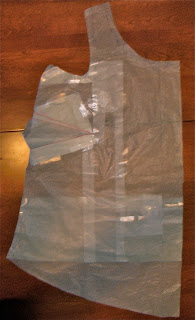
Fig. 5.  Behold!  The Frankenpattern!

Friday, August 26, 2011

Maternity Sorbetto Muslin Fitting


So, aided by my trusty helper (I can trust that he will always stop whatever he is doing and come lay on my sewing) I cut the modified Sorbetto pattern pieces out of muslin and machine basted them together. I didn't bother putting the binding on the armholes or neckline because they're not necessary for fit and that's all I'm looking at right now. I didn't hem it either, just sewed a basting stitch where the hem would fall after being sewn so I would have some idea where that would be. I did sew the pleat down to just past the bust, pressed it, and basted it at the top to sort of anchor it down.

So, the first issue materialized as I was sewing the side seams.


Evidently, despite my efforts to curve the hemline back to the tip of the original side seamline, the back is still shorter than the front. So, I'll adding length to the back for sure.

Then, I tried the muslin on.


It looks surprisingly good, given all of my adjustments and the fact that I'm a novice at pattern adjusting!

The good stuff:
  • The belly area doesn't look as tentish as I feared after cutting out the modified pattern (which just means that my belly really is that big now *sigh*) although there's definitely room for my belly to grow so I will be able to wear this top for awhile (I live in the SF Bay Area, so we will be having sleeveless top weather for awhile yet).
  • I like where I ended the pleat. It gives definition to the top of the...uh...top and offers something to draw the eye away from the big honkin' belly below. For the real deal, I may embellish the pleat more, maybe with buttons or a little bit of lace or ribbon down the sides of the pleat? I don't know, we'll see what inspiration grabs me.
  • By not sewing the pleat all the way down the front, I did get extra room for my belly, so that little bet paid off.
  • The bust darts are at the right level, pointing straight at the "apex" of my bust (I guess it's not common in sewing to just say "nipple").
  • For the most part, I like how the shoulders, neckline and underarm fit which tells me that starting with a size 10 in that area was a good idea.
The not-as-good stuff:
  • Well, obviously, I need to add some length to the back so it will match the front
  • I'm going to add length to the front, too. I like the length exactly how it is without the hem. So, I need to add the amount of the hem (5/8 inch) to the front before adding length to the back.
  • There was a tiny amount of gaping under the arm that I pinched out.
  • The upper back feels a bit tight just above the waist. Now, this could be due to problems in the bust, but I don't think so for reasons I'll get into later.
  • The bust darts seem a little long, ending almost at the apex. I might make them about half and inch shorter.
The major issue:

  • It is way too tight in the bust.
So, the biggest modification I need to make is to add room in the bust. I first tried removing some of the stitching in the pleat so that it was shorter and left more room for my bust. But, I didn't like how that looked (there was a distinct increase in tentness) so I resewed it. So, in order to figure out just how much to add to the bust area, I needed to slash the middle of the top, to see how much it spread apart at the bust. But, of course, I had this pleat there and as soon as I started slashing, the pleat was going to have all of this extra fabric flapping around. So, I sewed down the sides and middle of the pleat in order keep it tacked down during the slashing.

I didn't take a photo of this part because I'm not keen on putting pictures of me in my bra on the internet. So, trust me when I say that I there was a gap of about 2.5 inches in the bust area after slashing. Now, I assume that if I do an FBA to add 1.25 inches (since the pattern piece is half of the front, I need to use half of the total gap distance), I will end up with a fitted bust. However, the pattern is supposed to have about 3 inches of ease (I figured this out by looking at the pattern size chart and comparing the finished measurements of the bust to the sewist's bust measurement). That's 1.5 inches of ease for the front. So, I'm trying to decide if that means I should add 0.75 inches to the side seam at the bust and do an FBA for 1.25 inches or should I do an FBA that adds 2 inches to the bust (1.25 + 0.75) in order to get the proper fit?

The upper back was still a bit tight after slashing the front so I think that I need to add some width there. Again, there should be 1.5 inches of ease across the back and at the moment, it's skin tight. So, I need to add 0.75 inches to the pattern piece (which is 1/2 of the width of the total back). I'm guessing that means that I simply need to go up a size or two in that area to get the back right.

So, more pattern modifications and a new muslin are in the works (also a trip to the fabric store because I am fresh out of muslin). Hopefully this new round of modifications will fix the current problems without creating new ones!